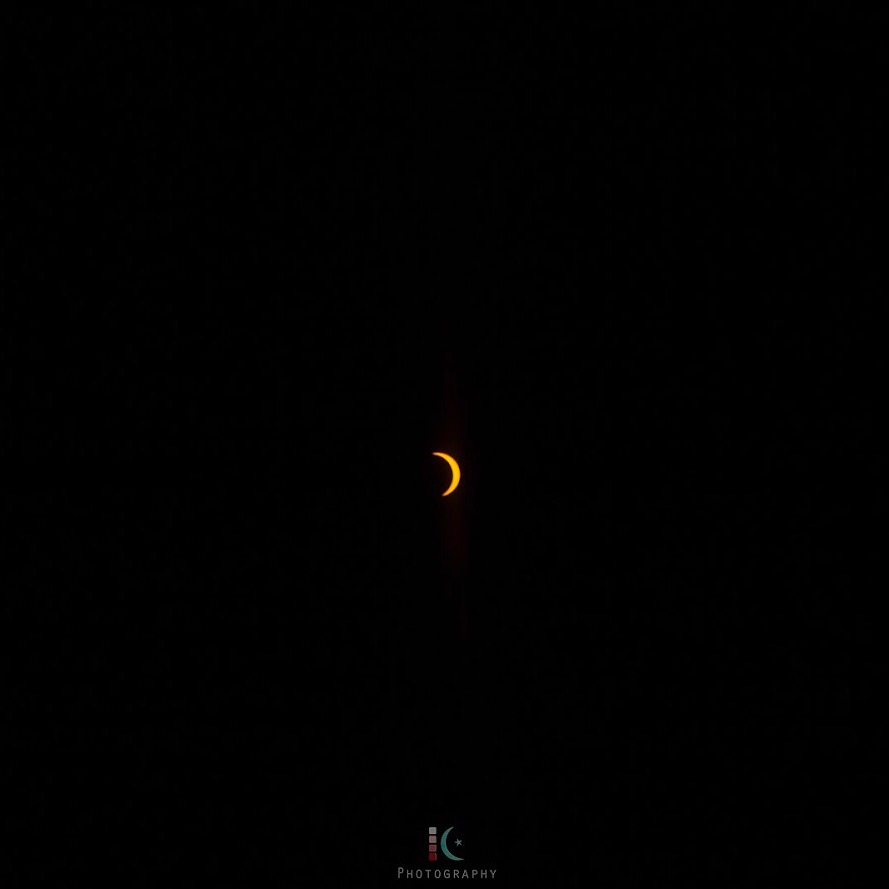
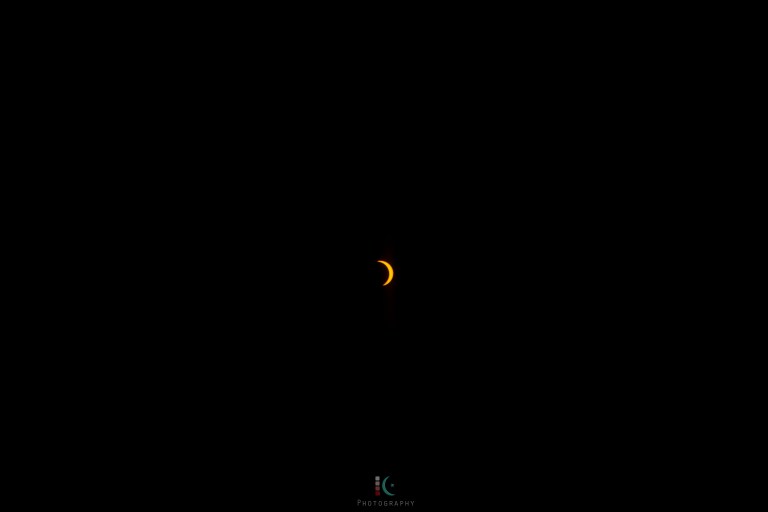
Westminster, Colorado @ August 2017 Photo: Huseyin Karadeniz
A Pale Light in the Darkness
On August 21st, The United States had the solar eclipse for second time in its history with a path of totality crossing the from the Pacific to the Atlantic coasts. Despite I had a chance to experience this breathtaking event in Denver with about 93% obscuration, it was still heart-stopping while the eclipse was briefly turning day into night.
While I was observing how the Moon passes between the Sun and the Earth, a wave of thoughts took me away to a different space and I started giving this remarkable natural events some thoughts.
Have you ever known that inside the distance between Earth and the Moon you can fit every planet in our solar space with about 2729 miles to spare? Yes, the gap is that big! The Sun 92.96 million miles away from the Earth, it takes sunlight an average of 8 minutes and 20 seconds to travel to the Earth. So, from technical standpoint while we were watching the totality, the sun was already moved way ahead in its trajectory.
The ratio of the Sun’s diameter to the Earth’s diameter is about 109. This means the ratio of their volumes is 109^3 which is about 1,300,000 and that means that 1,300,000 Earths should fit inside the Sun. It’s unbelievable, isn’t it? But wait a minute… There are stars out in space, much bigger than our Sun. Check out Arcturus which is over 16,000 times larger in volume than our Sun. Wanna go bigger? I present you, Alpha Scorpii A (Antares). It is about 690 million times larger in volume than our Sun. Staggering, isn’t it? But still not satisfied? Then here it is, I give you VY Canis Majoris. It’s over 2.9 million times larger in volume than our Sun. This means it’s insanely, incomprehensibly giant.
From the Earth to the Moon is about 238,900 miles which takes light approximately 1.26 seconds to reach there. Have you ever wondered how long the light would take to travel from one side of our Galaxy Milky Way to other? Approximately 100,000 light years in diameter. And we have barely left home galaxy for outer space. Compared with galaxies such as IC 1011 which is 6,000,000 light years wide, we are just teeny tiny! Consider the picture “Legion of Galaxies” Hubble Telescope took. It shelters thousands of galaxies, each galaxy containing billions of stars, and each star orbited by its own planets.
This reminds me of a passage from Karl Sagan’s famous book “Pale Blue Dot” (1997). “The Earth is a very small stage in a vast cosmic arena. Think of the rivers of blood spilled by all those generals and emperors so that in glory and in triumph they could become the momentary masters of a fraction of a dot. Think of the endless cruelties visited by the inhabitants of one corner of the dot on scarcely distinguishable inhabitants of some other corner of the dot. How frequent their misunderstandings, how eager they are to kill one another, how fervent their hatreds. Our posturings, our imagined self-importance, the delusion that we have some privileged position in the universe, are challenged by this point of pale light.”
Photo: Monday, August 21, 2017
 Huseyin Karadeniz | Travel & Photography Journal